
The INclude Steps

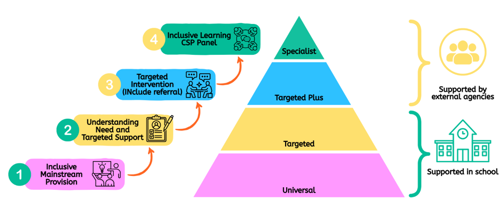
Inclusive Mainstream Provision is the universal offer available to all children and young people in mainstream schools. It is informed by the Inclusion Principles and delivered through an inclusive culture, high-quality adaptive teaching, positive relationships, and an environment that promotes belonging, participation, and achievement for every pupil.
Schools are expected to make effective use of their ordinarily available provision to anticipate and respond to the diverse needs of learners, removing barriers wherever possible through inclusive practice. This provision is available to all pupils and does not require referral, assessment, or access to specialist services.
This stage is reached when a child or young person is not thriving despite the Inclusive Mainstream Provision available to all pupils. It is the point at which a school identifies that a pupil may require support that is additional to or different from that ordinarily available through universal provision.
Schools should seek to understand the factors that may be creating barriers to learning, participation, attendance, wellbeing, or behaviour, considering these through the Seven Inclusion Principles. Schools are expected to work collaboratively with the child or young person, their family, and relevant staff to identify strengths, needs, and barriers to inclusion.
Using this understanding, schools should plan, implement, and review adaptations and targeted support that can be delivered through their own resources and ordinarily available provision. The focus at this stage is on understanding need, identifying barriers, and responding through targeted school-based support.
Examples may include:
- Reading, literacy, numeracy, and curriculum interventions
- Social communication and interaction support
- ELSA programmes and emotional wellbeing interventions
- School-based mentoring and trusted adult support
- Sensory circuits, sensory regulation strategies, and environmental adaptations
- Positive behaviour support and self-regulation strategies
- Support for attention, organisation, and independence skills
- Adaptations to teaching, routines, environments, curriculum access, and transitions
Schools should use an assess-plan-do-review approach to evaluate the impact of support and ensure that interventions are targeted, time-bound, and responsive to the child or young person's changing needs.
To strengthen their school-based response, schools can access online consultation for individual children and young people. These consultations provide advice and guidance to support schools in understanding need, identifying barriers, and refining their approaches, while responsibility for planning and delivering support remains with the school.
The expectation at this stage is that schools make effective use of their own resources to understand need and deliver appropriate adaptations and interventions. Where support has been implemented, reviewed, and refined but concerns remain, schools should consider whether additional specialist advice or involvement from the most appropriate service is required to support the identified need.
Where a child or young person's needs are creating barriers that may place them at risk of exclusion, placement instability, or disengagement from learning in the future, schools should consider referral to INclude Targeted Intervention. The purpose of INclude is to provide additional support to better understand and meet need, strengthen inclusion, and help change a child's trajectory before concerns escalate.
Further resources and information on Understanding Need and Targeted Support can be found on our Routes to Inclusion (R2i) webpages
INclude Targeted Intervention provides additional specialist education support for children and young people whose needs cannot be fully met through school-based adaptations and interventions alone.
This stage is reached when a school has developed an understanding of a child or young person's needs, implemented and reviewed targeted support through its own resources, and continues to have concerns about inclusion, engagement, attendance, wellbeing, behaviour, or progress. INclude Targeted Intervention is intended to be preventative, supporting children and young people whose needs may place them at risk of future exclusion, placement instability, or disengagement from learning.
The purpose of INclude Targeted Intervention is to work in partnership with schools, children, young people and families to further understand need, strengthen inclusive practice, and identify effective approaches that will support the child or young person to remain successfully included within their educational setting.
Partnership Planning Meeting
Following referral, support is planned collaboratively through a Partnership Planning Meeting, where outcomes are agreed and the most appropriate support is identified based on the individual needs of the child or young person.
Areas of Support
Targeted Intervention may be delivered through three broad areas:
Developing Practice
Supporting schools to strengthen inclusive practice, build staff confidence, and develop approaches that better meet the needs of children and young people.
Assessing and Planning
Gathering information, assessing barriers to inclusion, and supporting schools, children, young people and families to develop a shared understanding of need and effective plans for support.
Direct Support for the Child or Young Person
Targeted work with children and young people to address identified barriers, promote inclusion, and support positive outcomes.
How Support Is Delivered
Support is delivered by the most appropriate professional or combination of professionals, depending on the needs identified through the referral and Partnership Planning process. As a result, the practitioners involved may vary from case to case to ensure children, young people and schools receive the most relevant and effective support.
Monitoring and Reporting
For monitoring and reporting purposes, INclude Targeted Intervention may be recorded as:
INclude Targeted Intervention - Education Led
Support is provided through education services only.
INclude Targeted Intervention - Multi-Agency
Support involves education services working alongside health and/or social care partners. This distinction is used for monitoring, evaluation and service planning purposes. The intervention pathway and intended outcomes remain the same.
Where targeted intervention has been implemented and reviewed, and significant concerns remain regarding a child or young person's ability to access and sustain their educational placement, consideration may be given to referral to the Complex Support and Placements Panel.
The Complex Support and Placements Panel is the stage at which it is recognised that, despite the implementation and review of targeted intervention, a child or young person's needs continue to present significant challenges to their successful inclusion within their current educational setting.
This stage is considered when school-based adaptations, targeted support and specialist intervention have been explored and concerns remain regarding the child or young person's ability to access, engage with, or sustain their placement. The purpose of the panel is to ensure that children and young people with the most complex needs receive the right level of support, at the right time, through a coordinated and evidence-informed decision-making process.
The panel brings together relevant professionals to review the child's strengths, needs, outcomes and the support that has already been implemented. Consideration is given to the effectiveness of previous interventions, the child's current circumstances, and what additional support may be required to promote successful inclusion and positive outcomes.
The Complex Support and Placements Panel may consider:
- Access to enhanced specialist support
- Additional resources or provision to support inclusion
- Alternative provision where appropriate
- Specialist educational placements
- Other recommendations to ensure needs can be effectively met
The panel seeks to identify the most appropriate support and provision based on the individual needs of the child or young person, ensuring that decisions are made in partnership with schools, families and relevant professionals.
The aim is always to achieve the best possible outcomes for children and young people and to ensure that support is proportionate, timely and responsive to their assessed needs.
INclude involvement is intended to strengthen understanding, reduce risk and support sustainable change. Support may conclude when:
- Risks have reduced
- The situation has stabilised
- A clear ongoing support plan is in place
- Progress can be demonstrated against agreed outcomes
The conclusion of INclude involvement does not mean that a child or young person no longer requires support. It means that the school has the knowledge, strategies and planning needed to continue that support.
